Why Mining Digitalisation Fails in Practice Even in 2026?
Chitradip Pramanik
•
January 20, 2026
Digital Transformation
Introduction: The Gap Between Digital Strategy and Operational Reality
The mining industry invests billions into digital transformation initiatives each year. Advanced automation systems, artificial intelligence platforms, Internet of Things sensor networks, and cloud-based analytics solutions are deployed across operations globally. Yet most mining companies struggle to realise the promised operational improvements. Projects exceed budgets, implementation timelines slip by years, and expected productivity gains fail to materialise.
This paradox reveals a harsh truth: technology is the easy part. The real challenge is implementation. 69% of mining leaders report that skills gaps in digital capabilities represent their greatest obstacle to successful transformation.
Simultaneously, the operating environment is deteriorating. Operational complexity now ranks as the number one business risk for mining companies, surpassing commodity price volatility and supply chain disruption. Functional silos and declining ore grades have forced mining companies to process 40% more material to extract equivalent quantities of valuable minerals compared to 1991 benchmarks. These interconnected pressures create systematic dysfunction that erodes profitability.
Digital transformation is often positioned as the answer to these challenges. However, before organisations can unlock value from digital initiatives, they must first understand why so many digitalisation efforts fail in practice. This blog focuses on examining the most common barriers that prevent mining companies from translating digital ambition into operational impact, based on real-world industry experience and observed failure patterns.
Market Growth and Investment Trajectory in 2026
The mining industry continues accelerating digital transformation investment despite acknowledged implementation challenges that remain substantial. Industry analysis indicates that 21% of mining companies intend to invest more than 20% of their additional capital budgets inartificial intelligence over the next 12 months. This substantial commitment reflects widespread recognition that digital capabilities provide essential competitive advantages for mining companies competing effectively in 2026 and beyond.
This accelerating market growth reflects both increasing mining company investment in digital capabilities and declining technology costs that make digital solutions accessible to mid-tier and smaller mining operations. Equipment manufacturers including Sandvik and Epiroc increasingly integrate autonomous functionality and Internet of Things sensors into production equipment as standard features rather than optional upgrades, reducing incremental costs for mining companies adopting digital technologies. This standardisation of digital capabilities across equipment reduces barriers to digital adoption.
Software vendors specialising in mining analytics, digital twin technology, and integrated operations platforms continue expanding their capabilities in response to growing demand. Platforms like MineOne™ are designed to integrate with existing mining systems, allowing different software tools to work together and reducing dependence on a single vendor. The platform increasingly partners with equipment manufacturers, system integrators, and mining consultants that understand mining operations deeply, improving implementation support quality and reducing project failure risk.
Why Mining Digitalisation Fails: The Five Critical Barriers to Implementation Success
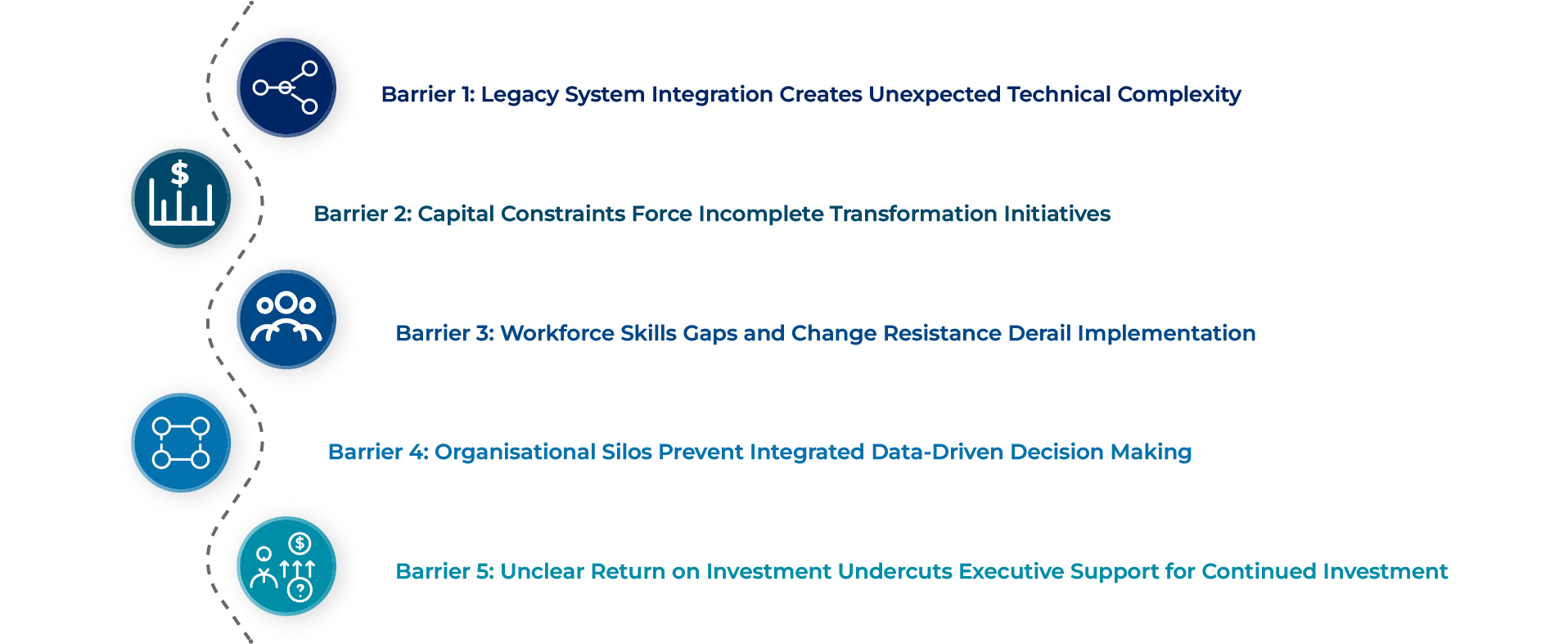
Barrier 1:
Legacy System Integration Creates Unexpected Technical Complexity
Most mining operations function within fragmented technology ecosystems where legacy systems, vendor applications, and in-house solutions rarely communicate effectively. When companies attempt to layer new digital technologies onto these disjointed environments, they often encounter technical complications that cascade throughout the entire project. Integration failures represent a primary cause of delays and cost overruns, often stemming from fundamental incompatibilities. A legacy resource planning system might use data formats that conflict with new cloud platforms, whilst equipment monitoring systems from different manufacturers frequently refuse to share sensor data through standardised protocols. Consequently, geological modelling software operates independently from production scheduling, forcing manual data transfers that introduce errors and create critical information delays.
This technical complexity is compounded by organisational realities. Different departments have invested substantially in legacy systems tailored to their specific workflows, from finance accounting platforms to specialised engineering design applications. When teams perceive new digital platforms as threats to their established systems rather than complementary additions, it creates political obstacles that extend implementation timelines. Furthermore, remote mining locations present physical challenges that centralised planning often underestimates. Extreme environmental conditions and limited bandwidth restrict the connectivity required by AI analytics and cloud-based systems, meaning companies often discover too late that their theoretical digital ecosystems cannot function reliably in the harsh reality of the pit.
Leading mining companies address this barrier by selecting flexible and customisable solutions that work alongside existing systems rather than demanding wholesale replacement.
Barrier 2:
Capital Constraints Force Incomplete Transformation Initiatives
Comprehensive digital transformation in mining demands enormous capital investment that exceeds available budgets at most mining companies. Autonomous equipment deployment typically requires hundreds of millions of dollars for widespread implementation across large operations. The cumulative costs of IoT sensor networks, AI analytics platforms, cloud infrastructure, and systems integration far exceed typical annual capital expenditure levels.
Mining companies face particularly acute capital constraints compared toother industrial sectors, with the weighted average cost of capital reaching between 8 and 10%, approximately double that of technology sector peers. This elevated cost forces companies to choose between digital transformation and other critical needs, such as equipment replacement, sustainability initiatives, and exploration programmes that directly support mineral reserves.
These constraints often lead to incomplete transformation approaches where companies implement limited digital capabilities rather than comprehensive solutions. An operation might deploy autonomous haulage in its highest-producing pit whilst maintaining manual operations elsewhere, or implement predictive maintenance for critical assets whilst ignoring routine maintenance optimisation. Such partial implementations fail to achieve the operational visibility and integrated decision-making required to drive maximum value.
Furthermore, incomplete transformation creates unintended consequences that undermine further investment: competing digital systems that obstruct performance. Autonomous equipment operating alongside manually controlled vehicles creates scheduling conflicts and safety hazards. Predictive maintenance systems recommend actions that conflict with production schedules developed without equipment condition data. These systemic conflicts erode confidence in digital tools and discourage the very investment needed to solve them.
Barrier 3:
Workforce Skills Gaps and Change Resistance Derail Implementation
Digital transformation requires mining workforces to develop proficiency with unfamiliar technologies, systems, and operational processes. However, traditional mining labour markets lack personnel with the combined expertise in mining operations and digital technology required for successful transformation.
This skills gap manifests in multiple distinct ways. First, companies must invest substantially in training programmes to upskill existing workforces. Experienced equipment operators require comprehensive training on autonomous system monitoring, whilst maintenance technicians need education in IoT sensor systems and predictive analytics. Production planners must learn to interpret AI-generated insights and integrate them into scheduling decisions. These investments divert resources from operational activities and create short-term productivity disruptions that complicate return on investment justification.
Second, recruiting new talent with digital capabilities remains extraordinarily difficult. University programmes face declining enrolment as graduates increasingly pursue opportunities in technology companies offering higher compensation and lifestyle advantages. The United States alone will lose approximately 50% of its mining workforce to retirement within the next five years, creating simultaneous challenges of experienced workforce departure and insufficient skilled replacement personnel. Similar workforce challenges exist across major mining jurisdictions globally.
Third, and perhaps most critically, experienced mining professionals frequently resist new technologies that they perceive as threatening their expertise or job security. An experienced mine manager with 30 years of operational knowledge struggles to accept that an AI system might recommend production decisions contradicting their intuition. A skilled equipment operator fears that autonomous systems will eliminate their position, whilst maintenance technicians worry that predictive systems devalue their troubleshooting expertise. These understandable concerns create organisational resistance that can derail even the most well-funded transformation initiatives.
Barrier 4:
Organisational Silos Prevent Integrated Data-Driven Decision Making
Mining organisations typically operate with strong functional silos where geological, operations, maintenance, and planning teams work in relative isolation. Each function has developed systems, processes, and success metrics optimised for their specific responsibilities rather than for overall operational performance.
This siloed structure creates planning and execution misalignment that digital technology cannot automatically resolve. Research indicates that alignment between planning departments and operational execution teams reaches only 30% in some mining operations. Geological teams forecast ore grades that planning departments use to establish production targets. Operations teams then discover that actual ore grades differ significantly from forecasts, yet production targets remain unchanged. Simultaneously, maintenance teams schedule servicing that conflicts with production schedules established without their input. The result is systematic dysfunction where different functions pull the operation in incompatible directions.
Digital systems implemented into organisations with these structural problems typically fail to deliver expected benefits despite substantial investment. A new AI analytics platform can generate insights about optimal production sequences, but if operations teams perceive these recommendations as threatening their autonomy, they will ignore or actively sabotage the system. Similarly, a predictive maintenance system can anticipate equipment failures weeks in advance, but if maintenance teams lack the budget authority to schedule preventive interventions, the system becomes irrelevant.
Barrier 5:
Unclear Return on Investment Undercuts Executive Support for Continued Investment
Mining executives approve digital transformation investments based on projected returns that often prove unrealistic when compared to actual operational outcomes. Consultants frequently propose comprehensive solutions promising efficiency improvements of 20 to 30% and cost reductions of 15 to 25%. These aggressive projections motivate initial investment approvals, yet actual results frequently fall short of these targets.
Disappointing results occur for multiple, interconnected reasons beyond simple optimism bias. Projected benefits assume full system functionality and complete workforce adoption, conditions that rarely exist in practice. Integration issues reduce system effectiveness, whilst workforce resistance limits utilisation rates. Furthermore, production disruptions during implementation phases often offset the initial benefits derived from improved systems. By the time projects conclude after extended timelines, executive leadership questions whether the investment generated adequate returns.
These diminished returns discourage continued investment. Mining companies that experience disappointment from initial projects become reluctant to fund subsequent initiatives, creating a vicious cycle where organisations most in need of transformation become the least willing to pursue it. To break this cycle, companies must look beyond simple productivity metrics and identify broader value drivers that justify the capital outlay.
Conclusion: Understanding the Problem Before Solving It
Mining digitalisation rarely fails because of a lack of technology. It fails because complex operational realities collide with fragmented systems, capital constraints, workforce limitations, and deeply entrenched organisational silos. As this blog has outlined, these challenges are not isolated issues but interconnected barriers that reinforce one another and undermine even well-funded transformation efforts.
Recognising these failure patterns is a critical first step. Without a clear understanding of where and why digital initiatives break down, mining organisations risk repeating the same mistakes, investing further capital without achieving meaningful operational change.
In the next version of this blog, we will shift focus from diagnosis to action. We will explore how leading mining companies are addressing these challenges in practice, the approaches that are proving effective, and what execution-led digital transformation looks like.
Until then, if these challenges resonate with your current reality and you are looking for immediate direction, we invite you to connect with us directly. Otherwise, stay tuned for the next edition, where we will move from understanding the problem to navigating the path forward.
Reactore MineOne isn’t just a software platform; it’s a game-changer. It transformed our mining operations, making them more efficient, cost-effective, and sustainable. We highly recommend Reactore MineOne to any mining company looking to stay ahead in this competitive industry.
Andrew Coleman
Chief Operations Officer
Global Minerals Corporation
Book a Demo
Experience Minone First-hand!
Thank you! Your submission has been received!
Oops! Something went wrong while submitting the form.
Devum saved our team time and money! Before Devum, software development was slow and expensive. Devum's low-code platform cut development time in half and lowered costs. Their easy-to-use platform and helpful support got us up and running quickly. Now we can focus on innovation and launch products we once thought impossible. Devum is more than just software, it's a partner that helped our business grow.
Alex Rivera
Chief Technology Officer
Innova Digitalisation Systems
Request a FREE Trial
Join the Low-code Revoultion Now. Claim Your FREE Trial!
Thank you! Your submission has been received!
Oops! Something went wrong while submitting the form.
RAMJACK Technology Solutions Having worked closely with the Reactore team over the past 5 years I can attest to their proactive, ‘can-do’ attitude. Not only is the MineOne platform an incredibly powerful tool for the mining industry; the team’s focus on the client’s specific requirements drives closer engagements and a longer lasting relationship. Reactore is fundamental in bringing together and visualising technology integration into a difficult environment
Rupert Birch
Vice President EMENA
RAMJACK Technology Solutions
Get in Touch
Join Hands for a Digital Transformation journey with Reactore!
Thank you! Your submission has been received!
Oops! Something went wrong while submitting the form.
Our partnership with Reactore, established in 2015, has been instrumental in designing and implementing innovative mining compliance systems. Their seamless approach translates complex regulations into user-friendly solutions, ensuring a smooth journey from concept to real-world application. This collaboration has consistently benefited LCS by allowing us to deliver superior value to our clients. Their ability to convert complex concepts into solutions that appear simple to the end user really is the ultimate sophistication!
Jaco Swartz
Managing Director
LCS (Pty.) Ltd.
Become a Partner
Join Our Partner Network
Thank you! Your submission has been received!
Oops! Something went wrong while submitting the form.