Digital Twins for Mining: How 3D Digital Twin Technology Improves Surface and Underground Operations
Pratyush Bhowmik
•
July 28, 2026
Industry Insights Tech & Innovation
What is a 3D Digital Twin for Mining?
A 3D digital twin for mining is a real-time, spatially-aware virtual replica of a physical mine that continuously updates with sensor data, showing equipment, personnel, and environmental conditions in a 3D interactive environment.
A digital twin in mining is a data-driven virtual replica of a physical mine or an entire mining system. Uniquely, a 3D digital twin is spatially aware, it is built on a true three-dimensional model of the mine environment (open pit, underground tunnels, plant, etc.) and continuously updates with real-time data from sensors and control systems. In other words, it is a living 3D map of the mine: as machines run or conditions change, the digital twin's 3D scene changes too. For example, live inputs can make surface haul trucks or underground assets or personals move in the model, or colour-code a pit wall to show stress levels.
In practice, a mining digital twin often combines engineering designs and geostructural models (CAD, GIS, BIM), mine planning and development with streaming IoT/SCADA data. This creates a single, up-to-date "source of truth" that shows how the mine was built and how it is currently performing. Unlike a static 2D drawing or even a 3D CAD model, the digital twin is dynamic: it reflects the live state of machinery, personnel , production and monitoring sensors, and other systems. In an underground mine, for example, a 3D twin can depict tunnels and haulage loops, overlay ventilation airflow and air-quality readings, and even show people and equipment moving through the tunnels in real time.
The upshot is that a 3D digital twin brings spatial context to operational data. Instead of disconnected charts or spreadsheets, operators see an intuitive virtual environment where they can zoom or select in on any area or asset and immediately view its latest condition. This visual approach makes complex problems easier to grasp, whether it's spotting an overloaded crusher bin, a developing fault in a pit slope, or congestion on the haul road. By merging real-time data into a 3D world, digital twins act as interactive decision-support tools for mining teams.
Digital Twin vs Traditional Models
Traditional mine models (CAD, GIS layers, static 3D scans) are useful for design and planning, but they remain static snapshots. In contrast, a digital twin is real-time and bidirectional: it receives live data from the field and can even send outputs (e.g., alerts or control signals) back to systems. As one industry source puts it, a traditional simulation is "static" and driven by predefined data, whereas a digital twin constantly evolves with real data. This means a twin can answer not just "what if" (like a simulation) but "what is happening now and what will happen next." In mining, where conditions can change suddenly, this real-time feedback loop is invaluable.
Here's how they compare:
Aspect
Traditional Models
3D Digital Twin
Data Flow
Static snapshots
Real-time, continuous
Updates
Manual, periodic
Automatic, instant
Decision Support
Historical analysis
Real-time + predictive
User Interface
Survey map sheets, spreadsheets
Interactive 3D environment
Table 1: Digital Twins vs. Traditional Models
From IoT Data to Decision-Ready 3D Dashboards
A 3D digital twin works by continuously collecting data from IoT sensors, PLCs, SCADA systems, RTLS, GIS, and mine planning software, then synchronising it with a virtual 3D model of the mine. Real-time operational data is acquired through industrial protocols such as MQTT, OPC UA, and Modbus, while enterprise applications and external systems are integrated using REST APIs and other system interfaces. This data is then linked to the corresponding equipment, infrastructure, or locations within the 3D model. As conditions change in the field, the digital twin updates in real time, giving operators a single dashboard to monitor equipment performance, personnel movement, enviromental conditions, and operational KPIs.
Industrial Application Development Platforms (IADP) such as Devum™, built on low-code principles, simplify this process with a built-in 3D engine, support for standard 3D formats (GLTF, FBX, OBJ, or any format), GIS integration, industrial data connectors, and configurable dashboard components. This enables mining companies to build and deploy production-ready 3D digital twins much faster. To learn more about the digital twin implementation process using low-code platforms, read our detailed blog on How to Build 3D Digital Twins Using Low-Code Application Platforms.
Why Are Mines Adopting Digital Twin Technology?
Mines are adopting 3D digital twins for three primary reasons: real-time visibility into disconnected systems, early hazard detection for safety, and predictive maintenance that reduces downtime. By combining data from equipment, geology, safety systems, and production into a single 3D environment, digital twins provide a unified view of the entire operation.
Improve Operational Visibility
Instead of switching between multiple applications, operators can monitor equipment performance, production rates, and sensor data from one interactive dashboard. This unified view helps teams identify issues faster and respond with greater confidence.
Enhance Safety and Risk Management
Underground mines present complex safety challenges. Digital twins visualise live data such as gas levels, ventilation, ground conditions, and personnel locations, enabling teams to detect hazards early, monitor worker safety, and test operational scenarios before execution. Early hazard detection can prevent incidents by alerting supervisors before critical conditions develop.
Increase Efficiency and Support ESG Goals
Digital twins improve predictive maintenance by identifying equipment issues before they lead to failures, reducing downtime and maintenance costs significantly. They also simplify compliance by consolidating environmental and operational data, making it easier to track emissions, water usage, energy consumption, and safety metrics required for ESG reporting.
The result: A connected, data-driven operation where mining teams can make faster, safer, and more informed decisions.
Key benefits of 3D digital twins in mining:
Consolidated visibility: One interface replaces a number of disconnected systems (SCADA, GIS, fleet management, sensors), reducing operator context-switching and improving situational awareness.
Predictive insights: Real-time analytics detect equipment failures days before critical breakdown, enabling proactive maintenance instead of emergency repairs.
Scenario testing: Run "what-if" analyses (e.g., new blast plan or schedule) in the virtual twin before executing them in the field, reducing rework and safety risks.
Enhanced safety: Proactive risk alerts (e.g., gas exceedances, slope movement) and live worker tracking in 3D space enable emergency response in seconds instead of minutes.
Faster decisions: Centralised dashboards mean managers don't waste time merging siloed reports; they see issues at a glance and act immediately.
Data Sources for a 3D Digital Twin in Mining
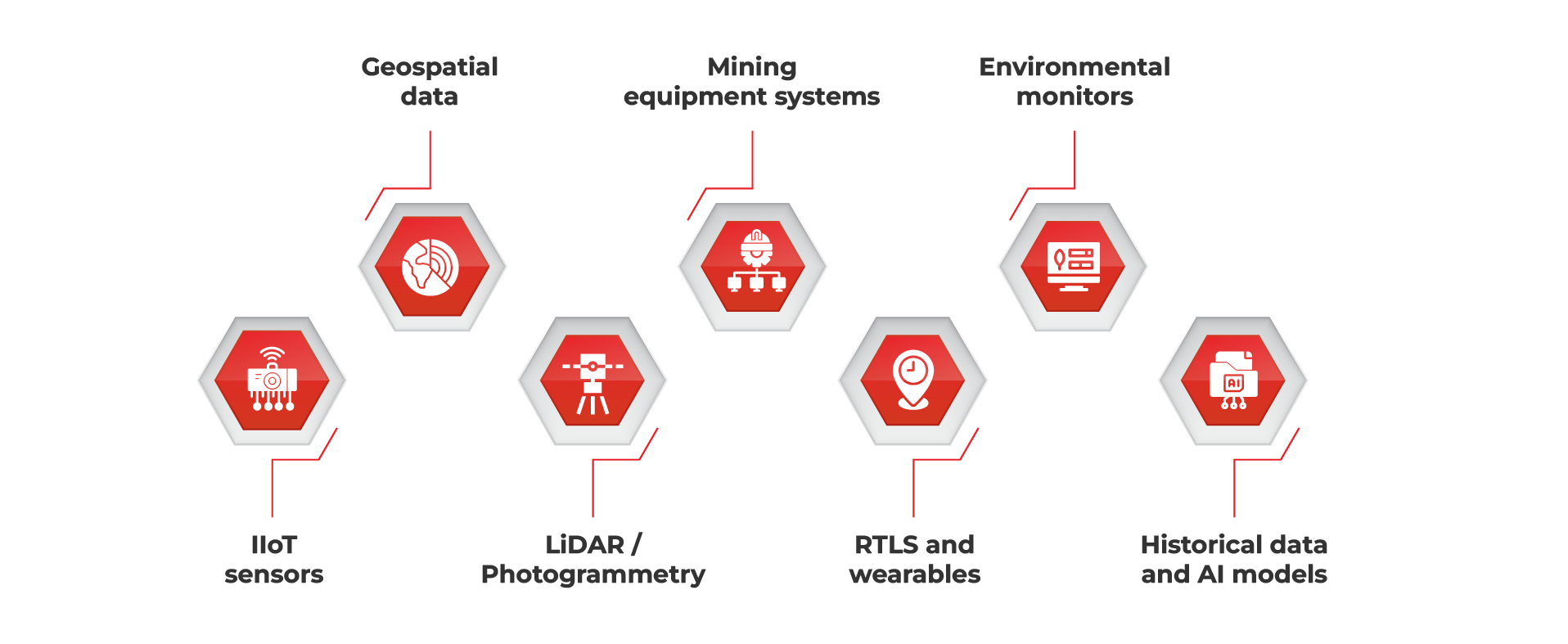
IIoT sensors: Vibration, temperature, pressure, gas, water levels, battery/power, etc.
Geospatial data: Geographic Information Systems (GIS) for terrain, BIM/CAD for plant layouts.
LiDAR / Photogrammetry: Drone or fixed scanning for stockpile/terrain volumes and updating mine surfaces.
RTLS and wearables: Real-time location tags on vehicles and personnel.
Environmental monitors: Weather stations, tailings dam sensors, noise/dust sensors.
Historical data & AI models: Past performance and ML predictions can feed the twin for predictive analytics.
By combining all these data sources, the twin becomes an operational replica. An operator can navigate a 3D map of the mine, click on a crusher to see its current throughput, or hover over a tunnel to check air quality, with the information overlaid live. This architecture dramatically improves situational awareness and decision speed.
Figure 1: Different Data Sources for a 3D Digital Twin in Mining.
3D Digital Twin Use Cases in Underground Mines
Underground mining presents unique challenges and is an ideal scenario for 3D twins. Spatial complexity, limited visibility, and high safety risks make real-time 3D dashboards invaluable. Key use cases include:
By integrating Real-Time Locating Systems (RTLS) with the twin, every vehicle and miner is tracked in 3D. For example, when a haul truck moves through tunnels, its position updates on the virtual map. If a person enters a dangerous zone (high gas, low oxygen), the system immediately flags that risk. Wearable sensors feed vital signs and geofence alerts into the twin, enabling supervisors to manage worker safety proactively.
Ventilation and Environment Monitoring
How can a digital twin help manage ventilation in deep underground mines?
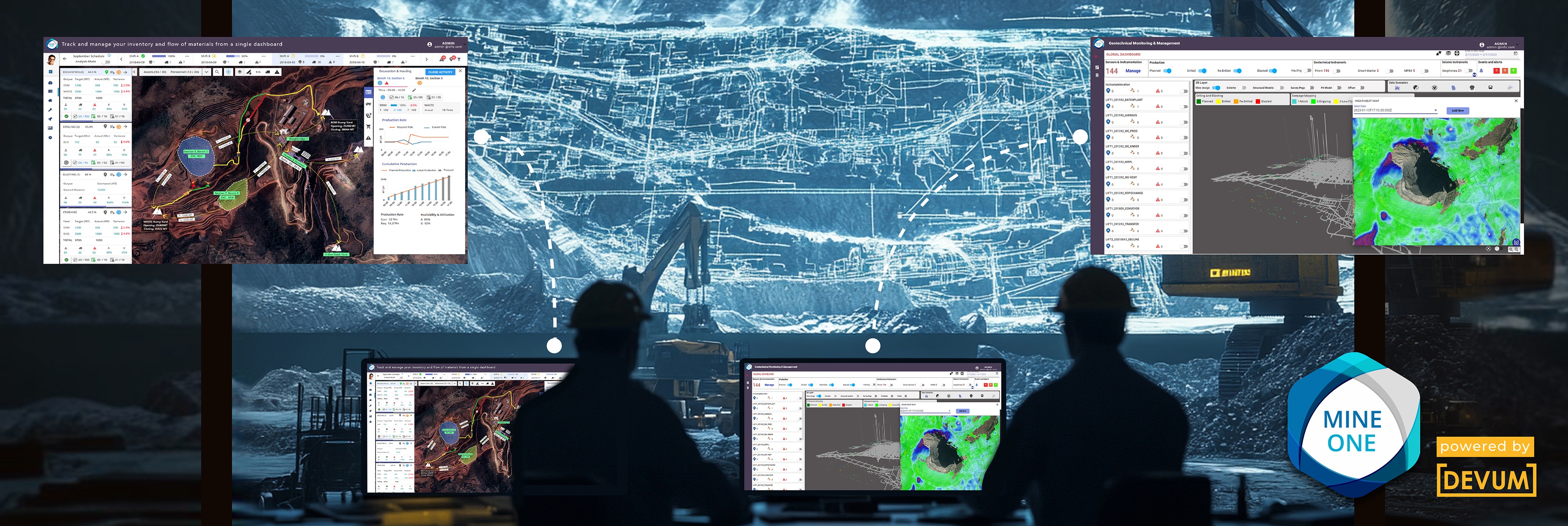
In deep mines, air quality is critical. A 3D twin overlays ventilation circuit models with live data (ventilation fans, airflow, gas levels, temperature). Operators visualise where fresh air is flowing or where a build-up of CO₂ or methane is occurring. In one example, a MineOne™ 360 dashboard built on Devum™ shows real-time airflow and sensor readings in an underground mine's ventilation system. If a fan fails, the twin instantly highlights which drifts might be affected, enabling quick countermeasures.
Rock and ground stability are major concerns. By integrating geotechnical sensors (extensometers, inclinometers, stressmeters and smart cable ) into the twin, engineers model ground behavior in 3D. For instance, a 3D digital twin combined with drone photogrammetry and radar data can simulate slope stability. When sensors detect movement, the twin's model updates, revealing a potential wedge failure. This predictive capability helps prevent collapses or flooding before they occur.
Equipment and Process Monitoring
Underground equipment (LHD, drill rigs, LPDT) can be represented in the twin. Teams monitor, for example, conveyor belt loads, battery levels of electric LHDs, or cycle times of haul trucks. If a subsystem is performing poorly, it stands out on the virtual scene. Integrations with the mine's control systems (SCADA) feed the twin so that, say, a rising belt motor temperature shows as a color change on the model, prompting preventative maintenance.
Emergency Response and Safety Drills
A 3D digital twin significantly improves emergency preparedness by providing a live view of personnel, equipment, and underground conditions during critical events. In the event of a fire, gas leak, roof fall, or other emergency, operators can instantly identify affected areas, track personnel locations, monitor evacuation progress, and coordinate rescue teams through a central 3D dashboard. When integrated with wearable devices and environmental sensors, the twin can also display real-time data such as heart rate, body temperature, gas exposure, and heat levels, helping emergency teams prioritise rescue efforts and respond more effectively.
Beyond real incidents, mining companies can use the digital twin to conduct virtual safety drills, evaluate evacuation routes, validate refuge chamber accessibility, and improve emergency response plans before an incident occurs.
3D Digital Twin Use Cases in Surface Mines
On the surface side, digital twins are equally transformative:
Fleet and Haulage Management
Open-pit mines rely on fleets of trucks, excavators, and shovels. A 3D twin can plot every vehicle on the pit map in real time using GPS/telemetry feeds. Dispatchers see truck locations, planned routes, and traffic density at a glance. Real-time alerts (like road blockages or equipment delays) can be given visually. Integration with fuel telemetry also allows monitoring diesel consumption per truck, helping reduce idling and emissions.
Crushing and Processing Lines
Many mines have complex plant circuits. A digital twin can represent the 3D layout of crushers, conveyors, mills, and stockpiles. Live process data (crusher throughput, conveyor loads, plant-level flows) is overlaid, enabling operators to optimise throughput and identify bottlenecks in seconds.
Stockpile and Terrain Monitoring
Large stockpiles and pits change constantly. Using drones with LiDAR (Light Detection and Ranging), 3D point-cloud scans are uploaded to the twin. This updates the terrain model frequently, so planners always know accurate volumes. For instance, drone LiDAR can calculate stockpile volume with centimeter accuracy. By incorporating these scans, the surface twin shows the evolving mine face or stockpile contours. Geotechnical sensors on tailings dams or dumps can similarly feed into the twin to track dam stability.
Environmental Management
Surface twins can integrate weather data, seepage monitors, or air-quality sensors. A lake, dam, or water treatment plant can be included in the site model with live levels and pump states. Dust monitors across the site feed into the 3D map, making it easier to enforce green buffers or spray regimes.
Pit Slope Stability
Like underground, open-pit slope failures are catastrophic. A 3D twin can incorporate geotech models of the pit slopes and stream deformation monitoring. By visualising cracks or movement vectors on the pit walls, it provides advance warning of instability. This enables mine engineers to take preventative measures before failure occurs.
These surface use cases demonstrate that digital twins can cover the entire pit-to-plant-to-port journey. By linking GIS, drone/LiDAR, sensor, and operations data, the twin gives managers a panoramic view of the entire open-pit mining process in one interface.
Where to Start: Digital Twin Roadmap for Mines
Implementing a 3D digital twin should follow a strategic roadmap to maximise ROI and adoption:
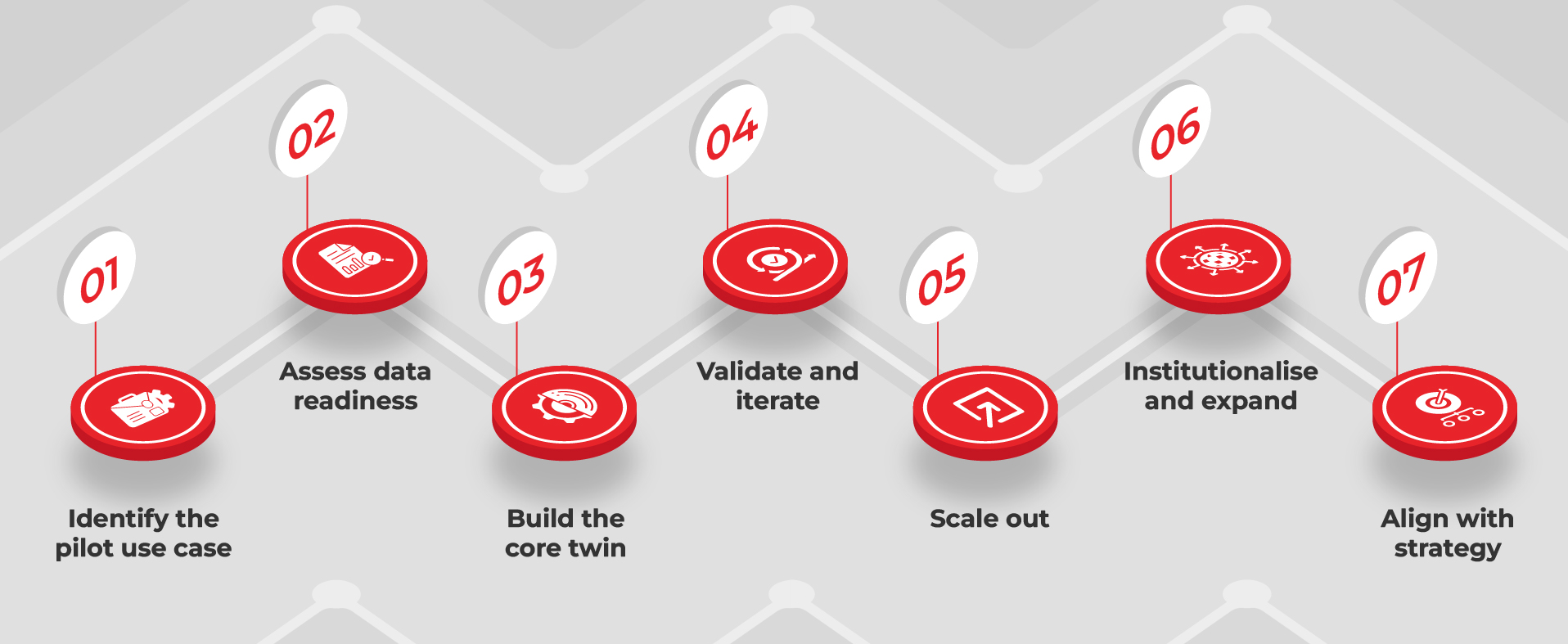
Identify the pilot use case. Choose a high-impact, well-scoped problem that benefits from real-time visibility, e.g., ventilation management, fleet optimisation, or a geotech risk area. A focused pilot builds proof of value quickly.
Assess data readiness. Inventory existing sensors, control systems, maps, and models. Address data gaps (e.g., install air quality sensors or deploy a few RTLS tags). Clean and unify data sources.
Build the core twin. Using a platform like Devum™, create the initial 3D model and dashboards for the pilot area. Involve operations teams early so the twin reflects real workflows.
Validate and iterate. Test the twin with actual users. Integrate additional data feeds as needed. Incorporate predictive alerts and analytics progressively.
Scale out. Once successful, roll the twin out to other parts of the mine, for example, expand from the pilot tunnel to the whole underground network, or from one pit area to the full open-cast site.
Institutionalise & expand. Establish data governance and ownership (the digital twin becomes an enterprise asset). Train staff. Consider adding advanced features (AI insights, mobile AR interfaces).
Align with strategy. Continually link twin capabilities to business goals (safety targets, ESG metrics, production KPIs).
Figure 2: A Roadmap for Implementing 3D digital Twins in Mines
Each step should involve cross-disciplinary collaboration between IT, engineering, and operations. The goal is to "think big, start small": win some quick wins with a limited twin, then grow it into a comprehensive system. Emphasise that the twin is not a one-time project but a continuously evolving tool that matures with the mine.
Conclusion
3D digital twins are transforming how mining companies monitor, manage, and optimise both surface and underground operations. By bringing together IoT, geospatial data, operational systems, and 3D visualisation into a single interactive dashboard, they give teams the real-time visibility needed to improve safety, increase productivity, and make faster, more informed decisions.
As mines continue their digital transformation, 3D digital twins will become a core operational capability rather than a specialised technology. The most successful implementations will start with a focused use case, integrate existing data sources, and expand gradually across the operation. With the right platform and implementation strategy, mining companies can move from disconnected data to a connected, decision-ready view of their entire operation, whether pit or underground.
Reactore MineOne isn’t just a software platform; it’s a game-changer. It transformed our mining operations, making them more efficient, cost-effective, and sustainable. We highly recommend Reactore MineOne to any mining company looking to stay ahead in this competitive industry.
Andrew Coleman
Chief Operations Officer
Global Minerals Corporation
Book a Demo
Experience Minone First-hand!
Thank you! Your submission has been received!
Oops! Something went wrong while submitting the form.
Devum saved our team time and money! Before Devum, software development was slow and expensive. Devum's low-code platform cut development time in half and lowered costs. Their easy-to-use platform and helpful support got us up and running quickly. Now we can focus on innovation and launch products we once thought impossible. Devum is more than just software, it's a partner that helped our business grow.
Alex Rivera
Chief Technology Officer
Innova Digitalisation Systems
Request a FREE Trial
Join the Low-code Revoultion Now. Claim Your FREE Trial!
Thank you! Your submission has been received!
Oops! Something went wrong while submitting the form.
RAMJACK Technology Solutions Having worked closely with the Reactore team over the past 5 years I can attest to their proactive, ‘can-do’ attitude. Not only is the MineOne platform an incredibly powerful tool for the mining industry; the team’s focus on the client’s specific requirements drives closer engagements and a longer lasting relationship. Reactore is fundamental in bringing together and visualising technology integration into a difficult environment
Rupert Birch
Vice President EMENA
RAMJACK Technology Solutions
Get in Touch
Join Hands for a Digital Transformation journey with Reactore!
Thank you! Your submission has been received!
Oops! Something went wrong while submitting the form.
Our partnership with Reactore, established in 2015, has been instrumental in designing and implementing innovative mining compliance systems. Their seamless approach translates complex regulations into user-friendly solutions, ensuring a smooth journey from concept to real-world application. This collaboration has consistently benefited LCS by allowing us to deliver superior value to our clients. Their ability to convert complex concepts into solutions that appear simple to the end user really is the ultimate sophistication!
Jaco Swartz
Managing Director
LCS (Pty.) Ltd.
Become a Partner
Join Our Partner Network
Thank you! Your submission has been received!
Oops! Something went wrong while submitting the form.