Best Underground Mining Solutions for Safety, Visibility, and Operational Control
Pratyush Bhowmik
•
June 24, 2026
Digital Transformation
Underground mining is one of the most demanding industrial environments on earth. Narrow headings, shifting ground conditions, limited line-of-sight, and the constant pressure to hit production targets create a combination of risk and complexity that surface operations simply don't face. And yet, many underground mines are still trying to manage that complexity with disconnected systems, end-of-shift reports, and gut feel.
That is changing fast. As mines go deeper, fleets grow larger, and regulatory expectations tighten, real-time underground visibility has moved from a nice-to-have to a hard operational requirement. Mines are now investing in integrated systems for geotechnical monitoring, short interval control (SIC), fleet management, and underground production tracking — systems that surface issues in the moment, not days later when nothing can be done about them.
This guide unpacks what underground mining solutions mean in 2026, which functional building blocks matter most, and how the leading platforms compare — so you can cut through the noise and find the right fit for your operation.
What Are Underground Mining Solutions?
Underground mining solutions are integrated digital systems that address the unique operational, safety, and environmental challenges of extracting ore below the surface. At their most capable, they combine geotechnical monitoring, fleet management, short interval control, production tracking, ventilation optimisation, and operational dashboards into a unified environment — giving teams a single, real-time picture of what is happening underground.
The best underground mining platforms don't just collect data. They connect it — turning instrument readings, truck locations, and shift plans into decisions that supervisors can act on in the moment.
The most useful way to think about these systems is by the questions they answer in real time:
• Is the ground stable, and are there any early warning signs of movement?
• Are crews in the right headings, with the right equipment, doing the right work?
• Is the production plan still achievable, or does it need to change?
• Are safety systems functioning, and is the environment within safe limits?
If your current stack can't answer all of those questions without a phone call or a manual report, there's a gap worth closing.
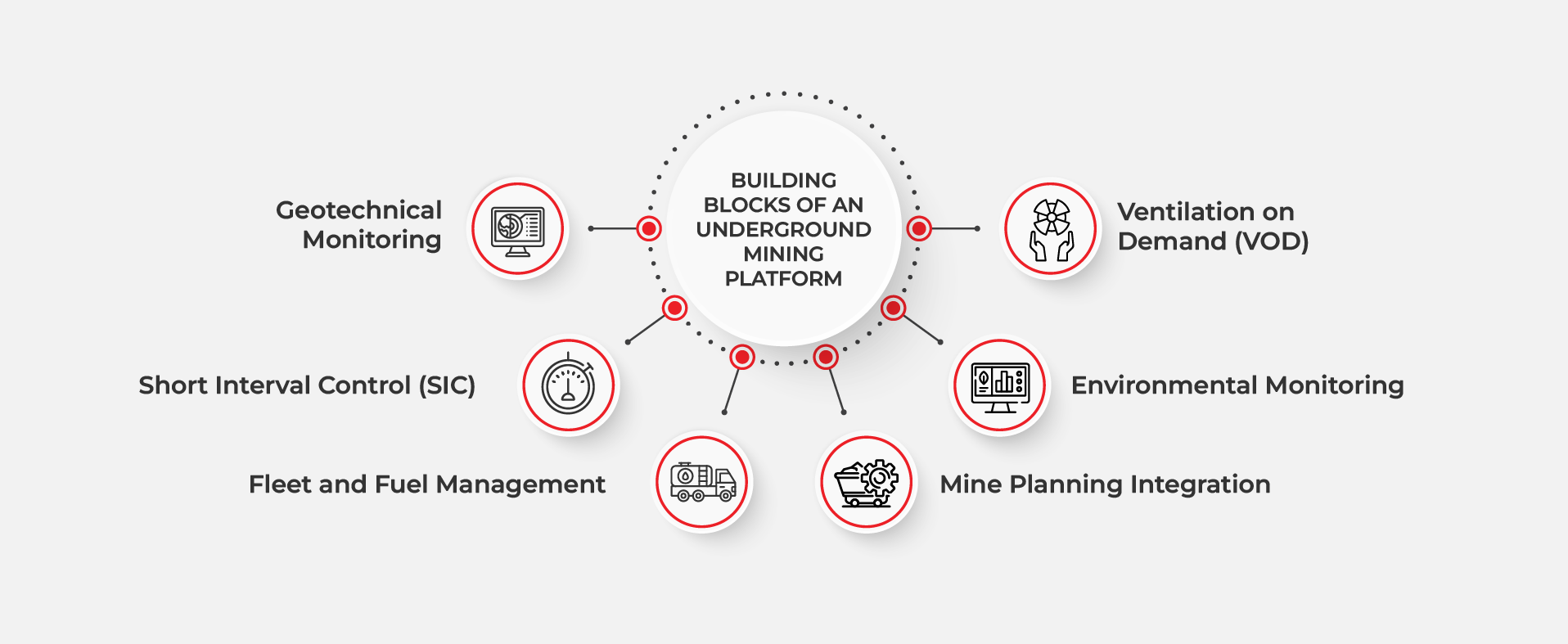
The Core Building Blocks of an Underground Mining Platform
Modern underground operations are too complex for any single tool to manage in isolation. The most effective digital environments are built from several interlocking components — each serving a specific function, but delivering their real value when they share data and workflows.
Geotechnical Monitoring
Ground behaviour is the foundational risk in underground mining. Technologies such as extensometers, piezometers, micro-seismic systems, LiDAR, radar, and deformation sensors continuously monitor rock mass conditions and underground stability. Modern geotechnical software consolidates these feeds into central dashboards with trend analysis,3D visualisation, and automated alerts — enabling geotechnical teams to identify risk earlier and adjust ground support, sequencing, and exclusion zones before incidents occur.
Short Interval Control (SIC)
SIC is the operational backbone of ahigh-performing underground mine. Rather than waiting for end-of-shift reports, SIC platforms monitor underground activities in near real time, helping supervisors respond immediately to delays, bottlenecks, and changing conditions. Core SIC capabilities include:
• Interval-by-interval production tacking
• Crew coordination and dynamic equipment allocation
• Underground dispatch optimisation
• KPI dashboards and shift-level variance reporting
Fleet and Fuel Management
Underground fleet management platformsprovide real-time visibility into equipment location, utilisation, and fuel consumption. In high-intensity operations with multiple loader and truck cycles running simultaneously, knowing where every machine is — and whether it's productive — is the difference between hitting plan and missing shift targets.
Ventilation on Demand (VOD) and Environmental Monitoring
VOD systems adjust airflow based on real-time conditions, reducing energy costs significantly while maintaining safe air quality for crews. When integrated with production schedules and fleet locations, VOD becomes far more precise — ventilating where work is happening, not where it was planned to happen hours ago. Environmental monitoring complements this by providing continuous visibility into critical underground conditions such as gas concentrations, dust levels, temperature, humidity, and airflow quality. Together, these capabilities help mines maintain safer working environments, support regulatory compliance, and make more informed operational decisions in real time.
Mine Planning Integration
Planning tools feed stope designs, schedules, and resource plans into the operational environment. The critical question is how tightly that plan connects to real-time execution — whether supervisors see plan versus actual continuously, or only when someone compiles a report.
The shift from point solutions to connected ecosystems is the defining trend in underground mining technology. Mines that integrate these capabilities into a shared operational environment see faster decisions, fewer surprises, and measurably better shift outcomes.
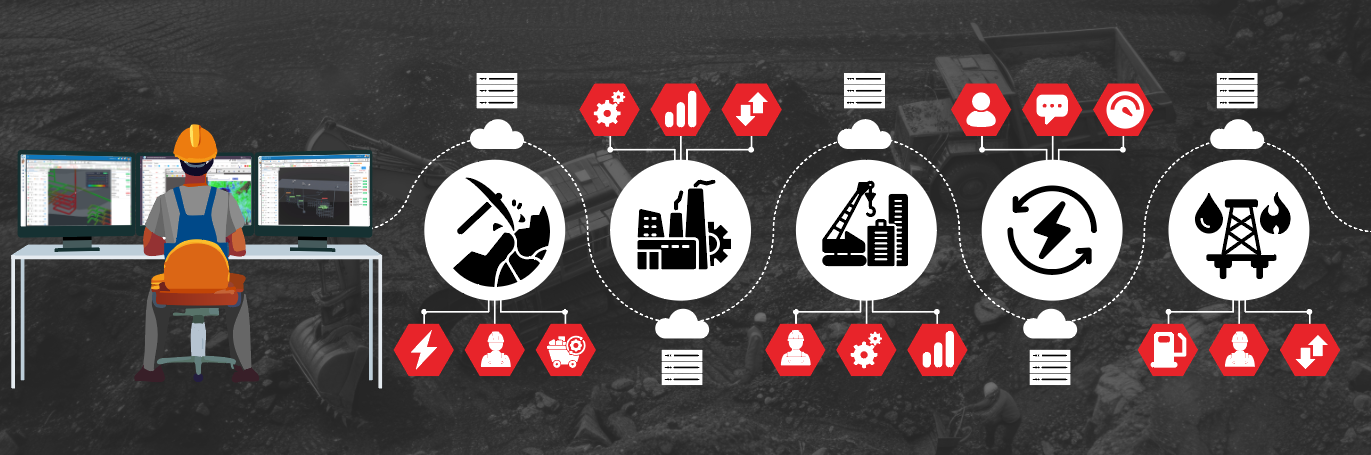
Integrated solutions powering efficient and safe underground mining operations.
The Best Underground Mining Solutions in 2026
The underground mining technology landscape spans planning specialists, SIC-native platforms, geotechnical monitoring systems, electrification providers, and fully integrated operational suites. Below is a structured, vendor-by-vendor comparison using a consistent framework— so you can see exactly where each platform excels and where it relies on others to fill the gaps.
MineOne™ Underground Solutions — Reactore™
MineOne™, developed by Reactore, positions itself as a unified pit-to-port operational platform that consolidates short interval control, fleet and fuel management, geotechnical and hydrological monitoring, ventilation on demand, asset management, and planning integration into a single mining-native environment.
The platform's core proposition is eliminating the fragmentation that comes from running multiple point solutions. Instead of integrating data manually across separate systems, MineOne creates a single operational source of truth with shared KPI dashboards that span surface and underground operations.
Technically, MineOne™ is built onDevum™, Reactore's proprietary Industrial Application Development Platform (IADP) — a low-code, microservices architecture that allows site-specific applications and customisations to be deployed and updated rapidly. This makes MineOne™ significantly faster to configure and integrate than competitors built on traditional enterprise software stacks, and means mines can keep their existing planning 'system of record' while using MineOne as the operational backbone that connects data, workflows, and decisions across the value chain.
Strengths: Integrated 3D digital twins; wide functional coverage across SIC, fleet, geotechnical, VOD, and planning; configurable workflows without custom development; ISO-certified data security; supports consolidated decision-making from a single operational dashboard.
Best for: Tier 1 and mid-tier operations looking to consolidate heterogeneous software stacks and close the gap between planning and real-time execution.
Pair with: Specialist tools where deep long-range planning capability is required, such as Deswik or GEOVIA for complex stope optimisation.
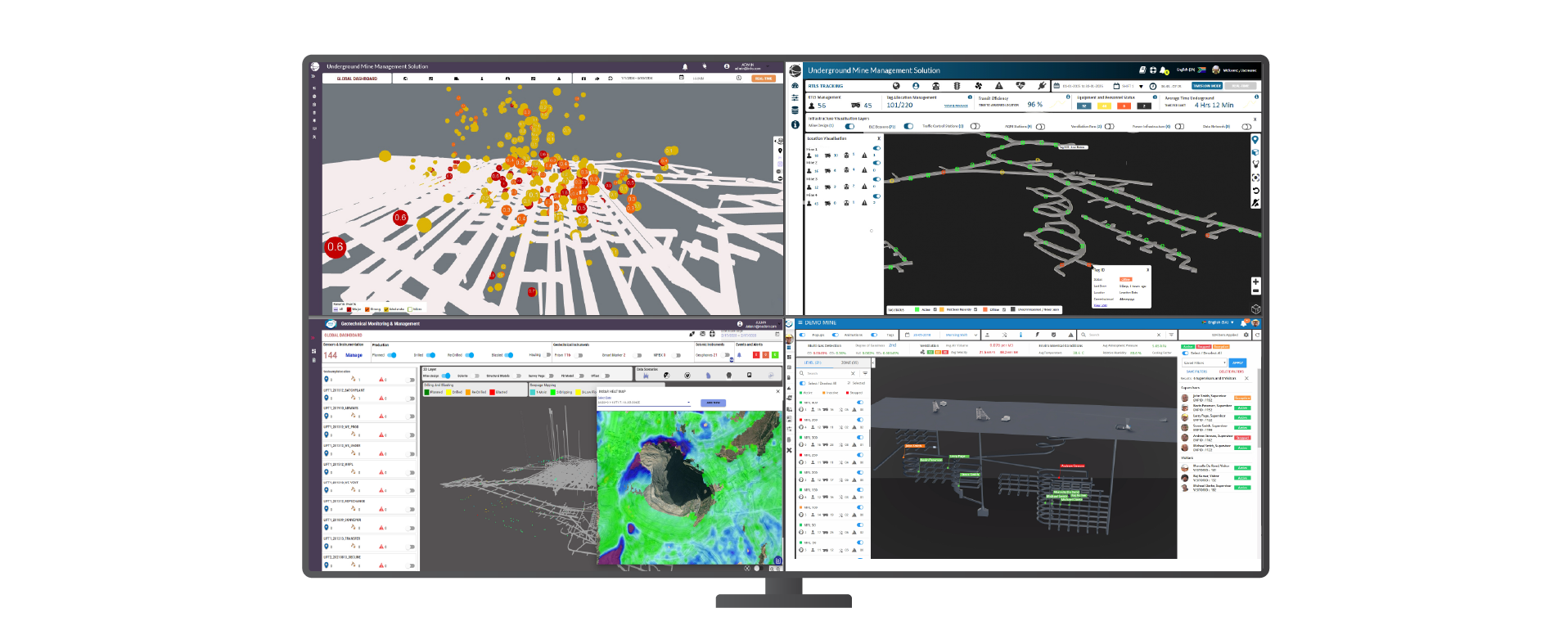
Visualising MineOne Underground Solutions in 3D interactive digital twin dashboards.
Deswik — Mine Planning and Scheduling
Deswik is a global leader in mine planning software, known for powerful 3D design, Gantt-based scheduling, and optimisation across the full mine planning value chain. Its portfolio — Deswik Spatial, Deswik Planning, APEX Optimizer, MDM, and OPS — is widely adopted in complex hard-rock underground operations that need sophisticated stope design, caving layouts, and long-range scheduling.
Deswik is fundamentally a planning-first platform. Even with its ORB SIC acquisition, mines typically still rely on separate tools or manual processes for day-to-day production execution, shift-level monitoring, and real-time variance response.
Strengths: Best-in-class design and scheduling for complex underground mines; strong optimisation; widely trusted by planners and geotechnical engineers.
Best for: Strategic and tactical planning, stope design, life-of-mine scheduling.
Pair with: Dedicated SIC, fleet management, and geotechnical monitoring tools to complete the operational stack.
GroundHog — Short Interval Control and Production Execution
GroundHog is a mining-native SIC and fleet management platform focused on translating plans into minute-by-minute execution. It automates shift planning, operator–equipment allocation, and real-time production tracking through a tablet-based, user-centric interface designed to work well in low-connectivity underground environments.
GroundHog is not a planning system and does not provide geotechnical monitoring, maintenance optimisation, or advanced safety capabilities. It concentrates on production metrics and SIC, requiring other systems around it to create a complete digital operations environment.
Strengths: Strong SIC and dispatch; tablet-first UX; well-suited to high-intensity underground operations needing real-time production control.
Best for: Shift-level scheduling, production tracking, and operator allocation in mines that already have a separate planning suite.
Pair with: Advanced mine planning, geotechnical monitoring, and asset or safety management platforms.
Hexagon — Safety Systems and Fleet Management
Hexagon combines underground fleet management with collision avoidance, operator alertness monitoring, and vehicle intervention systems. Its solutions are widely deployed at Tier 1 operations, providing OEM-agnostic visibility across mixed fleets and helping operators meet EMESRT Level 7–9 safety requirements.
Hexagon is not a mine planning or SIC platform. It delivers strong real-time awareness of equipment and safety events, but detailed production scheduling and short interval control are handled by separate systems. Enterprise-level cost and hardware requirements make it most suitable for large operations that can justify the investment.
Best for: Safety-critical fleets at large mechanised operations.
Pair with: Planning, SIC, and geotechnical systems to turn safety and fleet data into integrated operational control.
Datamine — Geology-First Mine Planning
Datamine offers a geology-first planning suite spanning exploration, geological modelling, design, and scheduling. MineScape and Studio products are widely used for stratigraphic deposits and complex geology, and Datamine's 2025–2026 evolution around digital twins and AI-assisted workflows continues to strengthen its role in modelling and simulation.
Operationally, Datamine remains focused on tactical and strategic scheduling rather than real-time SIC. Underground scheduling is generally regarded as less capable than specialised tools, and mines still need separate systems for production monitoring, fleet management, and shift-level control.
Strengths: Geological credibility; exploration-to-closure workflows; strong for coal and layered deposits.
Best for: Mines prioritising geology-led planning and digital-twin simulation.
Pair with: Dedicated SIC, fleet, and monitoring systems to close the planning–execution loop.
ABB — Electrification and Autonomy Infrastructure
ABB is an electrification and automation provider rather than a traditional mining software vendor. Its eMine platform spans power management, stationary and dynamic charging, trolley systems, on-board propulsion, and autonomous control — enabling mines to achieve major gains in haulage speed, maintenance reduction, and emissions performance. ABB is particularly compelling for Tier 1 mines under strong decarbonisation and ESG pressure.
ABB does not perform production planning, SIC, fleet dispatch, or geotechnical monitoring. Electrification and autonomy infrastructure must be integrated with separate planning, SIC, and fleet platforms to translate energy-aware capabilities into consistent operational performance.
Strengths: Electrification, trolley systems, energy optimisation, and autonomous haulage infrastructure.
Best for: Large operations designing or upgrading around electric and autonomous fleets.
Pair with: Planning, SIC, fleet, and monitoring systems to coordinate production with power and equipment constraints.
Bentley Systems / Seequent — Subsurface and Geotechnical Modelling
Bentley Systems, through its Seequent acquisition, delivers subsurface modelling, geotechnical analysis, and geological digital twins. Leapfrog, Geosoft, GeoStudio, and PLAXIS 3D together provide a powerful environment to model geology, analyse slope and stope stability, and manage geoscience data — particularly valuable for operations with complex geology, demanding regulatory requirements, and significant geotechnical risk.
Bentley/Seequent does not manage production panning or real-time execution. It provides the geological and geotechnical foundation on which planning and SIC systems depend.
Strengths: 3D geological modelling, geotechnical analysis, integrated subsurface digital twins.
Best for: Tier 1 mines with complex geology and strict geotechnical documentation requirements.
Pair with: Planning, SIC, and operational monitoring to act on subsurface intelligence in real time.
RPMGlobal (now part of Caterpillar) — Enterprise Planning and Optimisation
RPMGlobal specialises in enterprise-level scheduling, value optimisation, and mine-to-market planning. Its suite — XPAC, MinePlanner, XACT, Enterprise Optimiser, Product Optimiser, Fleet Planner, HAULSIM, and MinVu — covers long-range strategy, tactical and short-term scheduling, product value optimisation, and analytics across multiple mines and commodities.
Despite strong scheduling and optimisation capability, RPMGlobal is plan-first. It does not perform minute-by-minute SIC or automated equipment reallocation, and relies on integration with SIC, fleet, and monitoring systems to keep plans aligned with operational reality.
Best for: Large enterprises managing complex, multi-mine planning and financial optimisation.
Pair with: Real-time SIC, fleet management, and geotechnical monitoring for execution and safety.
GEOVIA (Dassault Systèmes) — Geological Modelling and Mine Planning
GEOVIA, led by Surpac, is a geology-first platform combining resource modelling, mine design, and scheduling with strong global market penetration across both open-pit and underground operations. Its suite — Surpac, MineSched, Whittle, and 3DEXPERIENCE GEOVIA — is valued for integrating geology, planning, and strategic optimisation, with a cloud-modernised future emerging through the 3DEXPERIENCE platform.
GEOVIA does not provide real-time SIC or detailed production control. Operations depend on separate SIC, fleet, and monitoring tools to execute plans and manage day-to-day performance.
Strengths: Popular geology and planning suite; strong in complex deposits and caving workflows; Dassault ecosystem alignment.
Best for: Mines prioritising rigorous geology-led plans and 3DEXPERIENCE platform integration.
Pair with: SIC, fleet, and monitoring platforms for execution, particularly in underground operations.
Canary Systems — Geotechnical and Environmental Monitoring
Canary Systems is a specialist in geotechnical monitoring and data integration, providing rugged hardware (MLRemote) and the MLSuite/MLWeb software platform to collect, manage, and analyse data from a wide range of instruments — prisms, radar, piezometers, extensometers, microseismic sensors, and tiltmeters. Its solutions are proven at scale in challenging environments, enabling early detection of ground movement and supporting proactive risk management.
Canary is not a planning, SIC, fleet, or execution system. It functions as a monitoring layer that requires manual or programmatic connection into operational workflows. Without tight integration, alerts stay within geotechnical teams and do not automatically translate into production changes or scheduling adjustments.
Real-time underground dispatch and production visibility.
Mines focused on shift execution and production consistency.
Very Strong
None
Strong
Hexagon
Safety and fleet management.
Collision avoidance, operator alertness and OEM-agnostic fleet visibility.
Mechanised underground mines with advanced safety requirements.
Strong
Indirect
Strong
Datamine
Geology-first mine planning.
Integrated exploration-to-planning ecosystem with digital twin capabilities.
Metals and coal mines needing geology-led planning.
Integration
Limited
Limited
ABB
Electrification and automation infrastructure.
Energy optimisation, trolley systems and autonomous haulage.
Large operations pursuing automation and decarbonisation.
Indirect
Indirect
Limited
Bentley / Seequent
Subsurface and geotechnical modelling.
Leapfrog, GeoStudio and PLAXIS for advanced geology and stability analysis.
Mines with complex geology and rigorous geotechnical requirements.
External
Very Strong
Limited
RPMGlobal (Caterpillar)
Enterprise planning and mine-to-market optimisation.
Parametric scheduling and multi-mine optimisation.
Large mining enterprises standardising planning.
External
Limited
Limited
GEOVIA (Dassault)
Geological modelling and mine planning.
Surpac-led geology and multi-method underground planning.
Operations driven by geological modelling and planning.
Integration
Limited
Limited
Canary Systems
Geotechnical and environmental monitoring.
Multi-instrument integration with MLSuite and MLWeb.
Geotechnically complex underground mines.
External
Very Strong
Growing
Where Underground Mining Technology Is Heading
The rate of change in underground mining technology is accelerating. Across the industry, three shifts are reshaping what 'good' looks like:
• AI-assisted operational control — platforms are moving beyond dashboards to prescriptive recommendations: which heading to prioritise, which truck to redeploy, which ventilation zone to adjust, all generated in near real time from live operational data.
• Predictive geotechnical monitoring — rather than alerting on threshold breaches, next-generation monitoring systems use trend analysis and machine learning to flag conditions that precede instability, giving geotechnical teams time to intervene rather than react.
• Integrated control rooms — the convergence of production, safety, fleet, and geotechnical data into single operational control rooms is making underground mines manageable from the surface with a level of visibility that simply wasn't achievable five years ago.
• Electrification and autonomy —as battery-electric vehicles and autonomous haulage become commercially viable underground, the software layer connecting power management, fleet dispatch, and production scheduling becomes the critical integration challenge.
The common thread across all of these trends is integration. Individual point solutions — however capable — can't deliver the real-time, cross-functional intelligence that complex underground operations now require. The mines that pull ahead will be those that build connected ecosystems, not just larger collections of tools.
The most valuable underground mining platforms in 2026 are not the ones with the most features — they are the ones that connect monitoring, planning, fleet visibility, and execution into a single operational environment where every team is working from the same picture.
Frequently Asked Questions
1.Why do underground mines need integrated visibility?
Data from geotechnical instruments, fleet systems, production schedules, and safety monitors is scattered across different platforms and teams. Without integration, mines rely on manual reporting and phone calls to understand what's happening underground — which means issues surface hours or days after they occur. Integrated visibility closes that gap, giving supervisors and managers a single, real-time operational picture they can act on immediately.
2.How should an underground mine choose the right digital solution?
Start with the problems you need to solve, not the technology. If short interval control and shift execution are the main gaps, a strong SIC platform may be the priority. If geotechnical risk is the driver, monitoring capability matters most. If you're managing fragmented data across multiple legacy systems, an integrated platform that consolidates workflows may deliver more value than adding another specialist tool. In most cases, the best outcome comes from a connected ecosystem — specialist planning software linked with SIC, fleet, and monitoring systems that share data and workflows.
3.What is Short Interval Control (SIC) and why does it matter?
SIC enables supervisors to monitor production performance on a shift-by-shift and interval-by-interval basis, so they can identify delays early, reallocate equipment dynamically, and respond to changing underground conditions before they derail the day's plan. Mines with strong SIC capability consistently outperform those relying on end-of-shift reporting, because problems are caught and resolved in hours rather than discovered after the fact.
4.How does geotechnical monitoring integrate with production decisions?
When geotechnical data is visible alongside production performance and fleet location in a shared operational dashboard, supervisors can adjust schedules, reassign equipment, or change routes in response to ground conditions — without making safety trade-offs against productivity. The key is integration: geotechnical alerts that stay within the geotechnical team are slower to act on than those that flow directly into the operational workflow.
5.What is Ventilation on Demand (VOD) and how much does it save?
VOD systems dynamically adjust underground airflow based on real-time conditions — crew locations, equipment activity, gas levels — rather than running at a fixed capacity around the clock. When integrated with fleet tracking and production schedules, VOD can reduce ventilation energy costs significantly while maintaining or improving air quality standards. For deep underground mines, ventilation energy is one of the largest operational cost lines, making VOD one of the fastest-payback technology investments available.
6. Can MineOne Underground Solutions integrate with our existing planning and ERP systems?
Yes. MineOne is built on Devum™, a low-code, microservices-based Industrial Application Development Platform designed for integration with ERP, SCADA, planning, fleet, and other enterprise systems. Mines retain their existing systems of record for planning and finance while using MineOne as the operational layer that connects data, workflows, and decisions across the value chain — without ripping and replacing what already works.
7. What should I look for in an underground fleet management system?
The most important factors are real-time location tracking, equipment utilisation visibility, integration with your shift schedule and production targets, and fuel management. For complex multi-fleet operations, the ability to dynamically reallocate equipment when disruptions occur — and to see the impact on plan vs actual immediately — is what separates a strong FMS from a basic tracking tool.
Ready to see MineOne™ Underground Solutions in action?
Contact Reactore to explore how MineOne™ can unify your underground operational environment.
Reactore MineOne isn’t just a software platform; it’s a game-changer. It transformed our mining operations, making them more efficient, cost-effective, and sustainable. We highly recommend Reactore MineOne to any mining company looking to stay ahead in this competitive industry.
Andrew Coleman
Chief Operations Officer
Global Minerals Corporation
Book a Demo
Experience Minone First-hand!
Thank you! Your submission has been received!
Oops! Something went wrong while submitting the form.
Devum saved our team time and money! Before Devum, software development was slow and expensive. Devum's low-code platform cut development time in half and lowered costs. Their easy-to-use platform and helpful support got us up and running quickly. Now we can focus on innovation and launch products we once thought impossible. Devum is more than just software, it's a partner that helped our business grow.
Alex Rivera
Chief Technology Officer
Innova Digitalisation Systems
Request a FREE Trial
Join the Low-code Revoultion Now. Claim Your FREE Trial!
Thank you! Your submission has been received!
Oops! Something went wrong while submitting the form.
RAMJACK Technology Solutions Having worked closely with the Reactore team over the past 5 years I can attest to their proactive, ‘can-do’ attitude. Not only is the MineOne platform an incredibly powerful tool for the mining industry; the team’s focus on the client’s specific requirements drives closer engagements and a longer lasting relationship. Reactore is fundamental in bringing together and visualising technology integration into a difficult environment
Rupert Birch
Vice President EMENA
RAMJACK Technology Solutions
Get in Touch
Join Hands for a Digital Transformation journey with Reactore!
Thank you! Your submission has been received!
Oops! Something went wrong while submitting the form.
Our partnership with Reactore, established in 2015, has been instrumental in designing and implementing innovative mining compliance systems. Their seamless approach translates complex regulations into user-friendly solutions, ensuring a smooth journey from concept to real-world application. This collaboration has consistently benefited LCS by allowing us to deliver superior value to our clients. Their ability to convert complex concepts into solutions that appear simple to the end user really is the ultimate sophistication!
Jaco Swartz
Managing Director
LCS (Pty.) Ltd.
Become a Partner
Join Our Partner Network
Thank you! Your submission has been received!
Oops! Something went wrong while submitting the form.