Closing the Safety Gap in Mining: How Real-time Digital Monitoring Helps Reduce Fatalities Across Underground and Opencast Operations
Pratyush Bhowmik
•
September 28, 2026
Safety & Compliance
By most measures, mining is safer than it has ever been, but it is not yet safe. Among ICMM member companies, which represent roughly a third of the global industry, total recordable injuries in 2025 were the lowest since ICMM began tracking them. Fatalities have not followed that trend: 39 people died at member operations in 2025, compared with 43 in 2024 and 35 in 2023. Fall of ground and mobile equipment remain the leading causes.
Some major mining jurisdictions are now going backwards. South Africa had recorded 49 mining fatalities by mid-September 2026, already more than the 41 recorded in all of 2025, which was a record low. The pattern is not confined to one country. The same high-consequence hazards continue to claim lives across operations worldwide: seismic events and falls of ground, collisions between heavy machinery and people, and atmospheric exposures.
For mine owners, executives and safety managers, the message is clear. Procedures, training and reporting have delivered real gains, but those gains are levelling off. The hazards that remain tend to develop quickly and are hard to see from the control room. End-of-shift reports, manual inspections and disconnected point solutions leave blind spots at the moments that matter most. Achieving Zero Harm now depends on closing the gap between a changing condition and the people who need to act on it.
What Is Happening in the Mining Sector?
Deep-level underground mines and large open pits face different hazards, but in both, the risk develops faster than traditional reporting can keep up with.
Underground: Seismicity and unexpected falls of ground, accumulation of toxic or flammable gases (CO, NOx, CH₄), interactions between vehicles and people in confined spaces, and limited visibility during emergencies.
Opencast: High-wall and slope failures, blind spots around heavy equipment, haul road traffic incidents, and adverse weather.
When these conditions are tracked through paper logs or systems that don't share data, control room teams often learn about ground movement or a gas build-up only after the situation has escalated. In high-risk environments, that delay is where serious incidents happen.
How Connected Monitoring Helps Prevent Mine Casualties
Most mines already have safety technology. The problem is that it rarely works together. Collision avoidance, personnel tracking, gas monitoring, slope radar and fleet management usually come from different vendors, each with its own screens, alarms and data. Where integrated platforms exist, they are often tied to one equipment manufacturer's ecosystem or built around a single function such as fleet.
MineOne® takes a different approach. It is OEM-agnostic and brings geotechnical, atmospheric, fleet, personnel and asset data into one time-aligned operational model, integrating down to PLC level. The control room can see a hazard, who and what is exposed to it, and act, including triggering alarms, strobes or ventilation where configured. Reactore's platforms are deployed across more than 50 mine sites on multiple continents, underground and in the pit.
Reactore is a software company first. MineOne integrates with the equipment, sensors, tags, radars and operational systems a mine already has, and where new hardware is needed, Reactore supplies it through its hardware partners and the OEMs. Supervisors, control room operators and safety officers then work from the same information, whether they are at a desktop or on a mobile device out in the workings, with an auditable record of alerts and responses to support compliance reporting.
1. Connected Underground Safety Monitoring
Underground, the most important questions are simple and urgent. Where are my people? Is the ground moving? Is the air safe to breathe?
Personnel tracking and Last Known Location (LKL): MineOne takes location data from RFID, Wi-Fi and mesh tracking systems and shows people alongside equipment and hazards on the same view. If power or communications are lost, each tagged worker's last known location is retained, giving rescue teams a clear place to start.
Geotechnical monitoring: Readings from extensometers, piezometers and micro-seismic systems, together with LiDAR scans, are brought into 3D digital twins of the workings. When deformation or pore-pressure thresholds are crossed, the right supervisors are alerted straight away.
Ventilation and air quality: Gas and dust sensors are monitored continuously for CO, NOx, CH₄ and particulates. Where ventilation systems are integrated, fan speeds can be adjusted automatically to keep active headings within safe limits.
Proximity detection: Events from proximity detection systems on machines and cap lamps are brought into the same view, so close calls between people and vehicles are visible to the control room, not only to the operator in the cab.
2. Opencast and Surface Risk Control
In an open pit, the risks are bigger in scale but can move just as fast. A pit wall can start moving with little visible warning, and a haul truck's blind spot can hide a light vehicle or a person on foot.
Slope and high-wall stability: MineOne integrates with slope radar, total stations and tiltmeters, so movement alarms reach dispatch and supervisors quickly and affected areas can be cleared early.
Collision avoidance: MineOne integrates with the site's collision avoidance systems (CAS), whether fitted by the OEM or supplied through Reactore's partners. Interaction events appear alongside fleet positions, exclusion zones and ground conditions, so near-misses and recurring patterns can be dealt with across the site, not just in individual cabs.
Geofencing and exclusion zones: Operators can draw exclusion zones on the digital pit layout around blast areas, unstable walls or closed haul roads, and change them as conditions change. If a vehicle or person crosses the boundary, an alert goes out automatically.
From Hazard Detection to Preventive Action: Why an Integrated Platform Matters
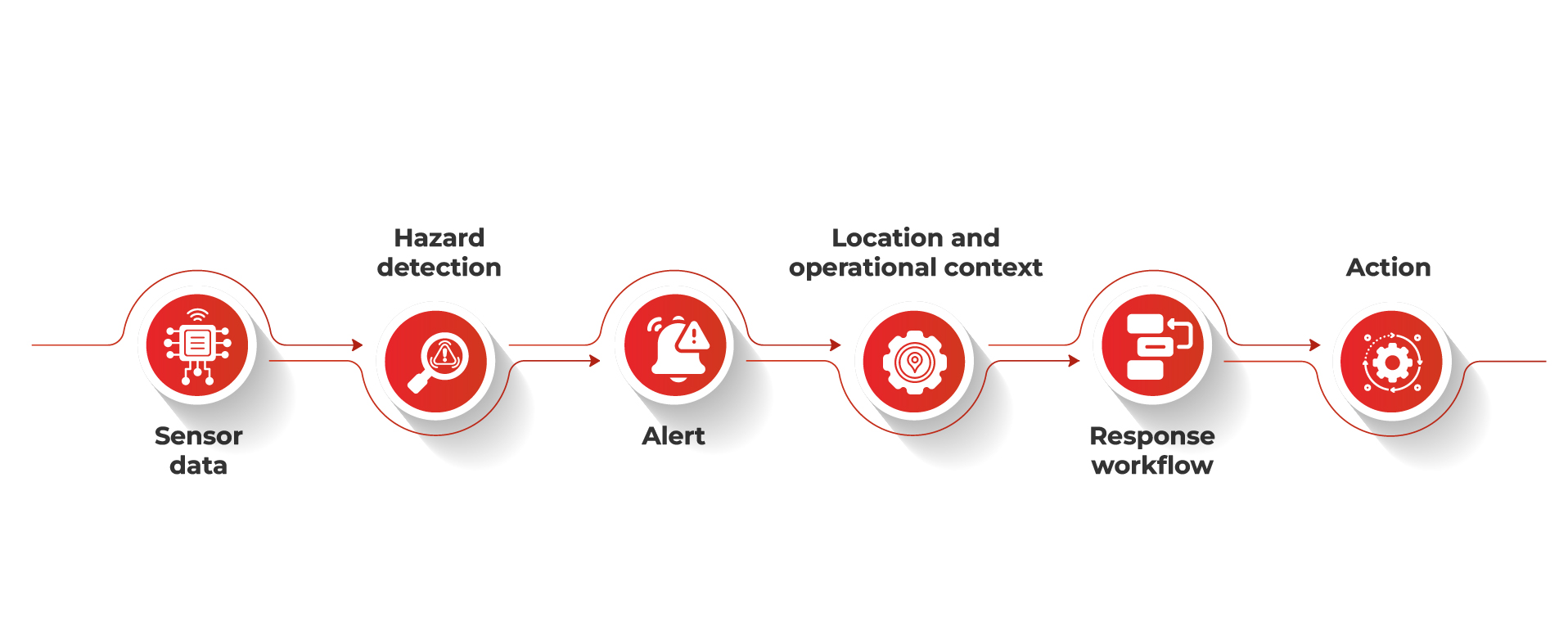
Detecting a problem is only half the job. Sensors may detect ground movement, a change in gas levels or a close call between a truck and a pedestrian, but that information only makes a difference if it reaches the right person, with enough context to decide what to do.
An integrated platform brings together sensor data, hazard alerts, personnel and equipment locations, operational workflows and response actions in one place. That shifts safety from collecting data to acting on it: raising the alarm, clearing an area, re-routing the fleet and, afterwards, understanding what happened and why.
This is particularly important because mining operations often rely on multiple systems for fleet and fuel management, mine planning, geotechnical monitoring, environmental monitoring, personnel tracking and enterprise management. When these systems operate in isolation, it can be difficult to build a complete picture of what is happening across the mine.
This is where MineOne® fits into the broader digital mining environment.
MineOne®: Connecting Operational Visibility Across the Mine
Reactore's MineOne® is a modular suite of desktop and mobile applications for managing mining operations, mitigating risk and improving compliance, underground and on the surface.
Rather than treating fleet, geotechnical, environmental, personnel, asset and logistics functions as separate systems, MineOne connects them on a single operational data model. Mines can start with the modules they need most and add others over time, without starting again.
That matters for safety, because hazards rarely stay inside one department.
A geotechnical condition may change where vehicles can operate. A restricted zone affects fleet routing. A ventilation problem affects where crews can work. And in an emergency, the control room needs to know about people and equipment at the same time.
With everything connected, teams can see not just what has changed, but where it has changed, who or what may be affected, and what operational response may be required.
Why Configurability Matters Across Different Mining Operations
No two mines operate under exactly the same conditions.
Layouts, fleets, safety procedures, regulations and ways of working differ from site to site and country to country. Software that forces every operation into the same fixed process tends to get worked around rather than used.
MineOne is built on Devum™, Reactore's low-code poweredIndustrial Application Development Platform. Workflows, dashboards and applications can be configured to match how each site actually operates.
So when a mine needs to change a process, add a new sensor or support a site-specific procedure, it can do so without rebuilding its software from scratch.
Working With the Technology You Already Have
Digital transformation doesn't have to mean ripping out existing systems.
Most mines already run mine planning software, ERPs, SCADA, fleet systems and specialist monitoring equipment, often from several different vendors. That investment has real value.
The ability to integrate these systems is therefore an important part of a connected mining environment.
MineOne is designed to work with existing operational and enterprise systems, from OEM fleet systems down to PLCs, so mines can build on what they already have. Where new hardware is needed, Reactore sources it through its partners and the OEMs and integrates it into the same platform.
South Africa's rising fatality count this year is a stark reminder of the risks mining still carries. But the challenge isn't confined to one country, one commodity or one type of mine.
Every operation, underground or open pit, faces its own mix of ground, environmental, equipment and human risk. Not every incident can be predicted, and no technology can remove every hazard.
What technology can do is shorten the time between something changing and someone acting on it.
Real-time monitoring gives earlier warning of ground movement, poor air, equipment interactions, people in the wrong place and breached exclusion zones. Connect that to the workflows teams already use, and it becomes information people can act on.
For mining companies, the opportunity isn't to collect more data. It's to make sure the right information reaches the right people at the right time.
That holds true whether the mine is deep underground in South Africa, an open pit in Australia, a copper operation in South America or anywhere else in the world.
With an integrated platform like MineOne®, mine operators can strengthen protection for their workforce, support compliance with safety regulations, and build a more consistent foundation for Zero Harm across every site.
See MineOne in Action
Book a demo to see how MineOne helps protect people across surface and underground operations.
Reactore MineOne isn’t just a software platform; it’s a game-changer. It transformed our mining operations, making them more efficient, cost-effective, and sustainable. We highly recommend Reactore MineOne to any mining company looking to stay ahead in this competitive industry.
Andrew Coleman
Chief Operations Officer
Global Minerals Corporation
Book a Demo
Experience Minone First-hand!
Thank you! Your submission has been received!
Oops! Something went wrong while submitting the form.
Devum saved our team time and money! Before Devum, software development was slow and expensive. Devum's low-code platform cut development time in half and lowered costs. Their easy-to-use platform and helpful support got us up and running quickly. Now we can focus on innovation and launch products we once thought impossible. Devum is more than just software, it's a partner that helped our business grow.
Alex Rivera
Chief Technology Officer
Innova Digitalisation Systems
Request a FREE Trial
Join the Low-code Revoultion Now. Claim Your FREE Trial!
Thank you! Your submission has been received!
Oops! Something went wrong while submitting the form.
RAMJACK Technology Solutions Having worked closely with the Reactore team over the past 5 years I can attest to their proactive, ‘can-do’ attitude. Not only is the MineOne platform an incredibly powerful tool for the mining industry; the team’s focus on the client’s specific requirements drives closer engagements and a longer lasting relationship. Reactore is fundamental in bringing together and visualising technology integration into a difficult environment
Rupert Birch
Vice President EMENA
RAMJACK Technology Solutions
Get in Touch
Join Hands for a Digital Transformation journey with Reactore!
Thank you! Your submission has been received!
Oops! Something went wrong while submitting the form.
Our partnership with Reactore, established in 2015, has been instrumental in designing and implementing innovative mining compliance systems. Their seamless approach translates complex regulations into user-friendly solutions, ensuring a smooth journey from concept to real-world application. This collaboration has consistently benefited LCS by allowing us to deliver superior value to our clients. Their ability to convert complex concepts into solutions that appear simple to the end user really is the ultimate sophistication!
Jaco Swartz
Managing Director
LCS (Pty.) Ltd.
Become a Partner
Join Our Partner Network
Thank you! Your submission has been received!
Oops! Something went wrong while submitting the form.